
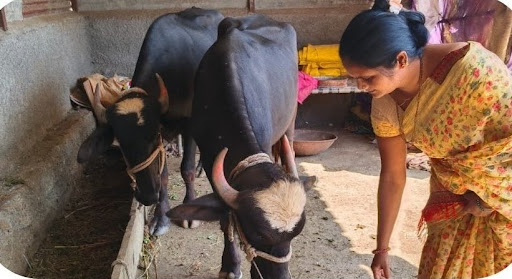
𝐇𝐨𝐦𝐞𝐦𝐚𝐤𝐞𝐫 𝐭𝐨 𝐂𝐥𝐢𝐦𝐚𝐭𝐞-𝐑𝐞𝐬𝐢𝐥𝐢𝐞𝐧𝐭 𝐅𝐚𝐫𝐦𝐞𝐫 𝐋𝐞𝐚𝐝𝐞𝐫
Reshma Badnale lives in Rampur village, Kamalnagar block of Bidar district, Karnataka. She is part of a joint family of six, balancing her roles as a homemaker, tailor, and farmer. While her husband works in the electricity department and supports farm activities, Reshma has always contributed quietly—through household work, stitching, and helping on the farm.
For years, farming remained uncertain. Rising input costs, chemical-dependent practices, and unpredictable rainfall affected both income and soil health. Despite working hard, Reshma had limited access to guidance, resources, or decision-making spaces.
Her journey took a new turn in January 2024 when she connected with Swayam Shikshan Prayog. Through SSP, Reshma received orientation and refresher trainings under the WCRF one-acre model. She attended residential training in Latur and exposure visits to Mahadevadi and Dewani villages, where she saw women farmers successfully practicing climate-resilient and organic methods.
Inspired by Malan Tai’s farming journey, Reshma began preparing and using bio-inputs like vermi-compost, vermi-wash, Dahinatra, Kellisala, seed treatment, composting, and natural pest control. Shifting away from chemical farming, she saw clear benefits—not only for her land, but also for her family’s health and finances.
The results speak for themselves:
• Cost of cultivation reduced by 20%
• Vegetable yields increased by 25%
• Soil moisture retention improved, lowering irrigation needs
• Savings of ₹8,000–₹10,000 per acre per season
Today, Reshma is not just a practitioner but a leader. She has trained 100 women farmers on WCRF practices, facilitated access to wells through the panchayat, supported women to receive subsidised pipelines, and helped them secure small bank loans for farm equipment.
From a quiet contributor to a confident changemaker, Reshma Badnale is proving that when women farmers get the right support, they lead the way toward resilient and sustainable agriculture.
Swayam Shikshan Prayog
06 January, 2026


